
Although time and its measurement is a fundamental component of human life, a special type of clock which takes matters to the next level is the so-called
astronomical clock and whose purpose is not to measure time per se but to convey astronomical information and, in particular, the relative position of the
Sun and Moon as well as the zodiacal constellations and, in some cases, the position of the planets all as a function of time.
The oldest such effort to effectively emulate the overhead celestial sphere (ie a mini-planetarium) is the
Antikythera Mechanism which was discovered in 1901 totally by
accident by sponge divers off the coast of the Greek island of Antikythera. It has been dated to approximately 80 BC and it is believed to be the work of
Poseidonius of Rhodes. The Antikythera Mechanism is currently on display
at the National Archaeological Museum in Athens, Greece.
Note: The astrolabe is yet another instrument constructed to describe the overhead sky and monitor time. Some versions also
have religious implications such as the Muslim Qibla where a magnetic compass on the back side of the astrolabe helps the user identify the proper orientation
so as to point at Mecca for prayer. It is believed that astrolabes were first developed by the Greeks around the second century BC and were slowly adopted
throughout the known world of the time by numerous cultures. Astrolabes describe the position of the planets and prominent stars visible at a particular
latitude (see curved markings on each dial in the photo below) and, by extension, act as time-keeping devices. Similarly, they assist in the time of expected
sunrise which is vital for the Muslim religion and the timing of morning prayers. Today's planispheres can be said to be a direct extension of the ancient
astrolabe, for they function and inform the user of precisely the same information sought-after by users many centuries ago.
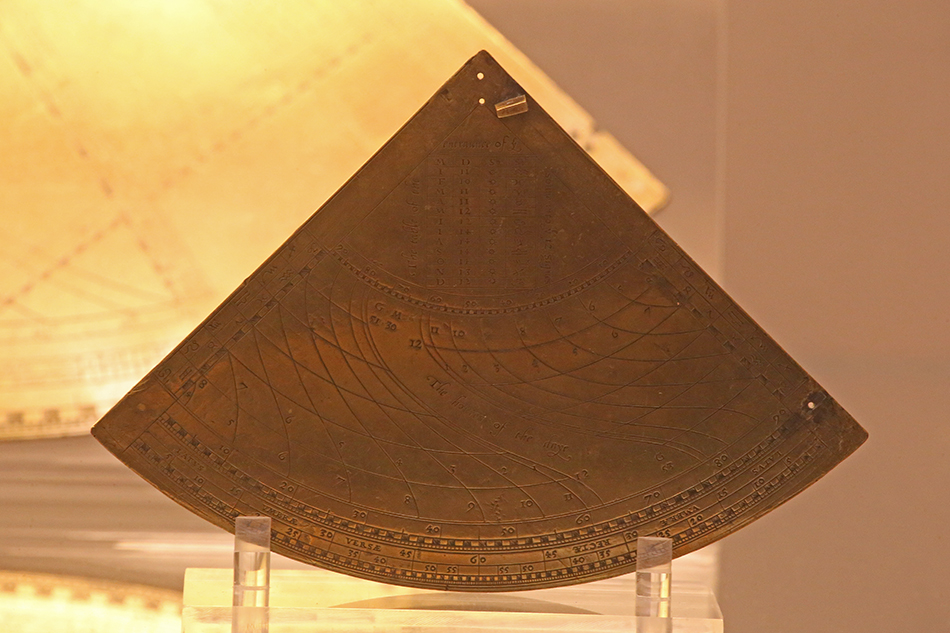
The brass astrolabe quadrant below is one of approximately six astrolabe quadrants in the collection of the British Museum. Astrolabe quadrants were simplified
versions of the more complicated standard astrolabe and were usually made either of wood or brass with a very small number made of other materials including iron
and ivory. The quadrant below is the work of the well-known English scientific instrument maker Humfrey Cole who worked out of London and with various of his
instruments having survived to modern day. The quadrant is dated 1571 AD and measures 12.3 cm in length and is 6.8 cm thick along the periphery. A sweeping arc
near center with the engraved text "The houres of the daye" is preceeded with the engraved latitude of 51° 30' and terminated with the engraved latitude of 53°,
thus establishing London as the focus of attention. The bottom of the quadrant is characterized with three rings: the innermost ring, running from left to
right, represents a graduated arc ranging from 0 to 90° with demarcations for every 10°; immediately below is a supplementary arc with equally spaced squares with
ten such squares for each marking in the arc immediately above and which effectively provides one-degree markings for each ten-degree interval; a third and final
graduated arc of the quadrant provides yet further accuracy using ten smaller white and black squares now representing 0.5° intervals. The apex of the quadrant
normally holds a plumb bob which swings depending on the angle produced when aligning the quadrant's sighting scope with the celestial object of interest, thus
immediately providing the altitude of the object such as the daytime Sun using graduated arcs. The determination of the altitude of a celestial object immediately
allows one to identify the local time and, hence, astrolabes and quadrants were vital timing devices and clocks. Of particular interest in the astrolabe below is the
depiction of the unequal hour system (aka temporal or seasonal hours) and where each day is divided into 12 segments for daytime (ie. sunrise to sunset) and nighttime
(ie. sunset to sunrise) irrespective of season. As a result, a segment for winter is much less than a segment during summer owing to the fact that days during winter
are much shorter than days during summer. This concept and discrepancy between segments and seasons is reflected by the very slanted arcs seen in the astrolabe below
and which dominate its front side. The second set of arcs which are only slightly slanted represent the modern-day concept of time and where hours are of equal
duration but with day and night represented by a variable number of hours depending on seasonality (ignoring the equinoxes). The six-hour scale on the periphery
(bottom-left) completes the depiction of time.
The British Museum in central London is widely regarded as one of the finest museums in the world. Founded in 1753 AD, the British Museum boasts the largest
permanent collection in the world with over eight million works, is comprised of ninety-four galleries and is rewarded with about six million visitors annually.
Admission to the British Museum is free but an online ticket reservation is highly recommended for quick entry with visitation hours being between 10:00 and 17:00
daily with Friday's closing hour being later (20:30). Public transportation includes four stations all around the museum (Tottenham Court Road, Holborn, Russell
Square and Goodge Street).
Note: For additional results involving astronomical clocks and astrolabes (including astrolabe quadrants) from around the world, please
click here.
|
Body: Sun Mass: 332,900 x Earth Mass Eq Diameter: 109.1 x Earth Distance: 149 million km RA / Dec: 23h 41m 41s / +89° 19' 51" Diameter: 32.16' Magnitude: -26.8 |
 |
Date: Dec 09, 2024 Location: British Museum, London, England Equipment: Canon EOS 6D Baader BCF2 Filter Canon EOS EF 70-200mm f/4 L @ 200mm / f11.0 Exposure: 1 x 1/80 sec ISO 6400 JPG Fine Image Format 5472x3648 Image Size Custom White Balance Continuous Servo Mode Manual Mode Software: Photoshop CS6 Processing: White Balance Adjustment Resampling JPG Compression |