
Although time and its measurement is a fundamental component of human life, a special type of clock which takes matters to the next level is the so-called
astronomical clock and whose purpose is not to measure time per se but to convey astronomical information and, in particular, the relative position of the
Sun and Moon as well as the zodiacal constellations and, in some cases, the position of the planets all as a function of time.
The oldest such effort to effectively emulate the overhead celestial sphere (ie a mini-planetarium) is the
Antikythera Mechanism which was discovered in 1901 totally by
accident by sponge divers off the coast of the Greek island of Antikythera. It has been dated to approximately 80 BC and it is believed to be the work of
Poseidonius of Rhodes. The Antikythera Mechanism is currently on display
at the National Archaeological Museum in Athens, Greece.
Note: The astrolabe is yet another instrument constructed to describe the overhead sky and monitor time. Some versions also
have religious implications such as the Muslim Qibla where a magnetic compass on the back side of the astrolabe helps the user identify the proper orientation
so as to point at the holy city of Mecca for prayer. Astrolabes were first developed by the Greeks around the second century BC and were slowly adopted
throughout the known world of the time by numerous cultures. Astrolabes describe the position of the planets and prominent stars visible at a particular
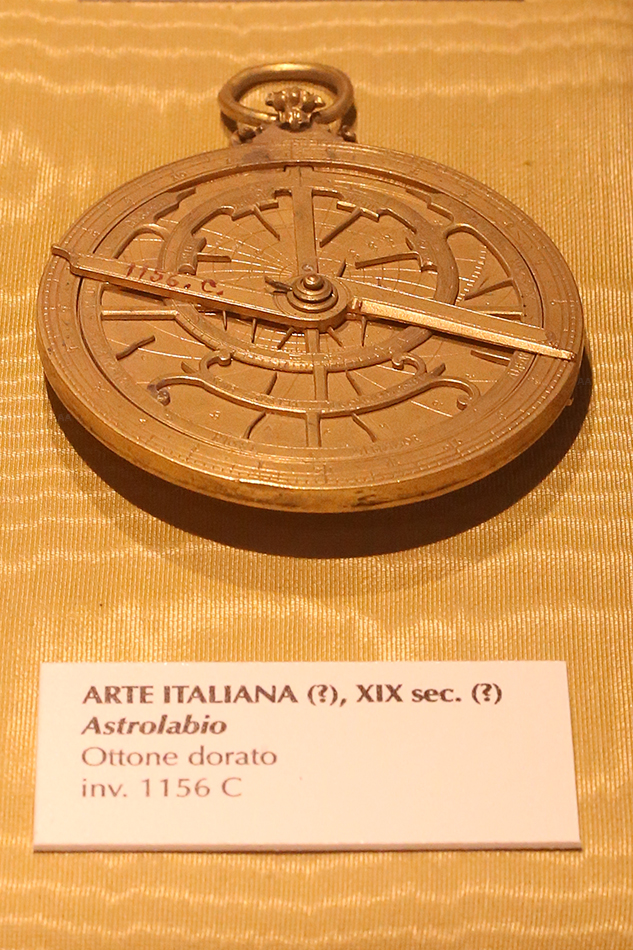
latitude (see curved markings on each dial in the photo below) and, by extension, act as time-keeping devices. Similarly, they assist in the time of expected
sunrise which is vital for the Muslim religion and the timing of morning prayers at dawn ("fajr") and thereafter at noon ("dhuhr"), afternoon ("asr"), sunset
("maghrib") and nightfall ("isha"). As a result, it is no surprise that the overwhelming number of astrolabes found in museums around the world are
islamic in origin given the adoption of these instruments from around 700 AD and thereafter by the Islamic World. Today's planispheres can be said to be a
direct extension of the ancient astrolabe, for they function and inform the user of precisely the same information sought-after by users many centuries ago.
The astrolabe below is part of the Carrand collection in Room II of the Museo Nazionale del Bargello, Florence. Although it was believed to be a fake, the
noted scientific instrument historian David King confirms its authenticity (see "In Synchrony with the Heavens", Volume 2, Page 37, 2005) but suggests that
the astrolabe and, more specifically, its rete is a mere copy of an Andalusian astrolabe from Toledo (1029-1030 AD) attributed to MuYammad ibn al-Oaff with
the copy having totally omitted the star names for the horizontal pointers. The unit on display at Museo Nazionale del Bargello is made from gold-plated
brass and which is the primary reason for the initial belief the astrolabe was fake. Nevertheless, the astrolabe is from Renaissance Italy and is believed
to be from the 19th century. No information is available as to physical size or weight but it does not exceed 10 cm diameter. Furthermore, it seems to
have a single (latitude) plate, thus being planespheric in nature, for it projects the three-dimensional celestial sphere onto a two-dimensional plane
comprise of a single disk. During the Middle Ages, three-dimensional astrolabes were first described but only one such example seems to have survived to
present day and which can be found at the History of Science Museum in Oxford, England (travel and photography forthcoming).
The historic center of Florence is characterized with a number of epic museums (with very impressive collections) which are a must-see while visiting the city.
One of the most impressive such museums is the Museo Nazionale del Bargello (Bargello National Museum) and which hosts one of the most prized collections
of Italian Renaissance art and, particularly, sculpture. Housed within Florence's oldest public palace since 1859, the museum's notable works of art include
masterpieces by Michelangelo, Donatello and Cellini. One will also find impressive collections involving ceramics, ivory, armour and coins. The museum is closed
on Tuesdays but open on every other day of the week from 08:15 to 13:50 except for Saturdays when the closing time is extended to 18:50 with admission costing 13
euro. The Museo Galileo is less than 400 meters to the south and only a few minutes away by foot while boasting a huge collection of astrolabes and astrolabe
quadrants including Galileo's astrolabe whereas the Fondazione Scienza e Tecnica with its impressive collection of scientific instruments from the nineteenth and
twentieth centuries is 1200 meters further north and boasts a Galleria dell'Astronomia with a rich suite of astronomical instruments including an astrolabe.
Note: For additional results involving astronomical clocks from around the world, please click
here.
|
Body: Sun Mass: 332,900 x Earth Mass Eq Diameter: 109.1 x Earth Distance: 149 million km RA / Dec: 23h 41m 41s / +89° 19' 51" Diameter: 32.16' Magnitude: -26.8 |
 |
Date: April 20, 2024 Location: Museo Nazionale del Bargello, Florence, Italy Equipment: Canon EOS 6D Baader BCF2 Filter Canon EOS EF 50mm/f1.8 USM @ f8.0 Exposure: 1 x 1/250 sec ISO 6400 JPG Fine Image Format 5472x3648 Image Size Custom White Balance Continuous Servo Mode Manual Mode Software: Photoshop CS6 Processing: White Balance Adjustment Resampling JPG Compression |