
Although time and its measurement is a fundamental component of human life, a special type of clock which takes matters to the next level is the so-called
astronomical clock and whose purpose is not to measure time per se but to convey astronomical information and, in particular, the relative position of the
Sun and Moon as well as the zodiacal constellations and, in some cases, the position of the planets all as a function of time.
The oldest such effort to effectively emulate the overhead celestial sphere (ie a mini-planetarium) is the
Antikythera Mechanism which was discovered in 1901 totally by
accident by sponge divers off the coast of the Greek island of Antikythera. It has been dated to approximately 80 BC and it is believed to be the work of
Poseidonius of Rhodes. The Antikythera Mechanism is currently on display
at the National Archaeological Museum in Athens, Greece.
Note: The astrolabe is yet another instrument constructed to describe the overhead sky and monitor time. Some versions also
have religious implications such as the Muslim Qibla where a magnetic compass on the back side of the astrolabe helps the user identify the proper orientation
so as to point at the holy city of Mecca for prayer. Astrolabes were first developed by the Greeks around the second century BC and were slowly adopted
throughout the known world of the time by numerous cultures. Astrolabes describe the position of the planets and prominent stars visible at a particular
latitude (see curved markings on each dial in the photo below) and, by extension, act as time-keeping devices. Similarly, they assist in the time of expected
sunrise which is vital for the Muslim religion and the timing of morning prayers at dawn ("fajr") and thereafter at noon ("dhuhr"), afternoon ("asr"), sunset
("maghrib") and nightfall ("isha"). As a result, it is no surprise that the overwhelming number of astrolabes found in museums around the world are
islamic in origin given the adoption of these instruments from around 700 AD and thereafter by the Islamic World. Today's planispheres can be said to be a
direct extension of the ancient astrolabe, for they function and inform the user of precisely the same information sought-after by users many centuries ago.
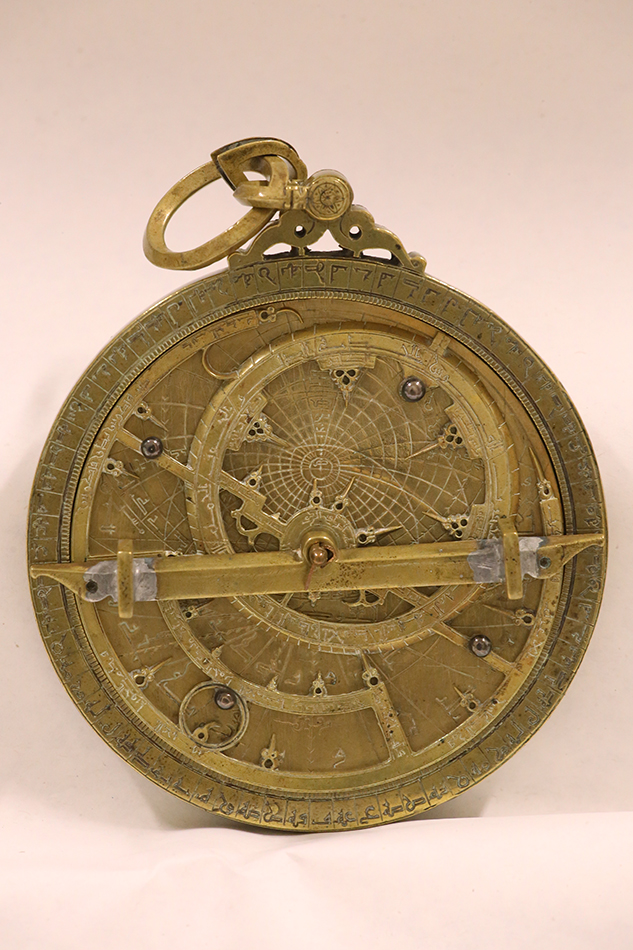
The impressive brass astrolabe below is one of two astrolabes at the Specola Museum in Bologna. It is comprised of approximately 29 star-pointers and a single-arm
rule. The astrolabe measures 11.7 cm in diameter and is accompanied by seven latitude plates which are suitable for users at latitudes 22 to 45 degrees; four of
the plates are believed to be original whereas the other three were probably later additions and produced to adapt the use of the astrolabe to other altiudes
including Italy. The inscriptions and the character set used as well as the latitudes of the original plates suggest a Moorish craftsman was responsible for its
construction with either Ibn Baso and/or his son Ahmad b. Husayn b. Baso being the likely candidates and who were active in the Maghreb region during the
latter part of the thirteenth century and, more specifically, the muslim-dominated Al-Andalus region in southeastern Spain. Since the astrolabe is accompanied by
the aforementioned latitude plates, it can be described as planespheric in nature, for it projects the three-dimensional celestial sphere onto a two-dimensional
plane comprised of a single disk. During the Middle Ages, three-dimensional astrolabes were first described but only one such example seems to have survived to
present day and which can be found at the History of Science Museum in Oxford, England (travel and photography forthcoming). The concept of a universal astrolabe
was described by the aforementioned Ibn Baso in one of many treatises he had published ("Treatise on the universal plate for all latitudes") and which not only has
survived to modern-day but is preserved at the National Library of Tunis. A second treatise by Ibn Baso, "General plate for all latitudes", comprised of 160
chapters and across three publications is preserved at the National Library of Tunis and the Royal Library of Rabat
(further details here).
The University Museum System in Bologna (Il Sistema Museale di Ateneo dell'Universita di Bologna) overlooks fifteen individual and specialized museums in and
around the city's university campus. One of these venues is the Specola Museum which is dedicated to astronomy. Located in the Specola Tower (built 1712-1726)
where astronomical research was carried out as early as the early 1700's under the auspices of the Institute of Science at the time, the Specola Museum today
is part of the Science Museum (Palazzo Poggi). The Specola Museum is compriszed of various thematic rooms which one encounters after climbing 272 steps to the
top of the Specola Tower. The museum is normally open Tuesday to Friday between 10:00 and 16:00 with a modest admission fee of five euro but is temporarily
closed due to structural damage to the Specola Tower and is expected to reopen during spring of 2025.
(see here).
Note: For additional results involving astronomical clocks and astrolabes (including astrolabe quadrants) from around the world, please click
here.
|
Body: Sun Mass: 332,900 x Earth Mass Eq Diameter: 109.1 x Earth Distance: 149 million km RA / Dec: 23h 41m 41s / +89° 19' 51" Diameter: 32.16' Magnitude: -26.8 |
 |
Date: Nov 19, 2024 Location: Museo della Specola, Palazzo Poggi, Bologna, Italy Equipment: Canon EOS 6D Baader BCF2 Filter Canon EOS EF 70-200mm f/4 L @ 154 mm / f11.0 Exposure: 1 x 1/50 sec ISO 6400 JPG Fine Image Format 5472x3648 Image Size Custom White Balance Continuous Servo Mode Manual Mode Software: Photoshop CS6 Processing: White Balance Adjustment Resampling JPG Compression |