
Coronal mass ejections from the Sun hurl highly-charged particles towards the Earth's atmosphere which collide with oxygen, nitrogen and
other molecules, thus displacing electrons. When these electrons recombine with other loose atoms, light is emitted which produces impressive
displays across the planet's two geomagnetic poles. To be more specific, the most common colour observed during such displays is green with
tints of yellow and which have as basis the excitation of oxygen atoms. In contrast, when nitrogen atoms are excited, one observes various
shades of blue and violet displays which are less sensitive to the human eye. Finally, excitation of nitrogen and oxygen, especially at lower
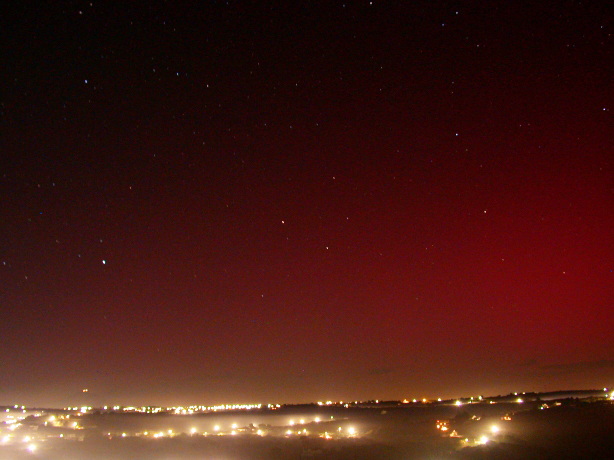
altitudes, yields displays which are rich in reds (as indicated by the examples below). Of course, most auroras produce a wide range and
combination of these "primary" colours and it is not unusual, for example, to observe streams of green and yellow flares during such a display.
Alaska is the best place in the northern hemisphere to observe these "dancing lights", for it represents the geomagnetic northern pole. When
coronal mass ejections are really massive, aurorae can be observed as far south as mid-California and the Scandinavian countries. Countries in
the Mediterranean are very far away from either of the two geomagnetic poles and, therefore, have a very low probability for the observation
of this marvellous phenomenon.
Note: Athens, Greece may have a geographic latitude of 38° N but what is of actual significance is the fact that
its geomagnetic latitude is 31° N. As a result, other locations may have a geographic location which is lower than Athens, they may be
characterized at the same time with a higher geomagnetic latitude and, therefore, have a much greater probability of having an auroral display.
For example, the southern-most tip of Florida (25° N, 80° W) is a full 13° further south than Athens and, yet, is characterized with a geomagnetic
latitude of 36° N or 5° greater than that of Athens.
The solar flare responsible for this auroral event was of type X-10.0. Type X flares are the strongest that can be hurled from the Sun and can
easily initiate planet-wide radio blackouts and long-lasting radiation storms. The intermediate M-class flares are responsible for brief radio
blackout usually around the geomagnetic poles with little impact elsewhere. Finally, C-class flares are relatively minor with little to no consquences.
With the image below, the star at center but towards the left is α-Lyr. Furthermore, both Lyra and Draco are visible and setting in this image.
Finally, the aurora ranged 50 degrees in azimuth (40 degrees west of north to 10 degrees east of north) and 30 degrees in altitude (starting from
the horizon).
Note: For additional results from the October and November, 2003 auroral display over Athens, Greece, please click
here.
|
Source: AR10486 CME Type: X-10 Geomagnetic Index: Kp-9 |
|
Date: Oct 30, 2003 23:38:56 UT+2 Location: Athens, Greece Equipment: Nikon Coolpix 995 Exposures: 46 sec @ f3.3 ISO 100 JPG RGB Fine image format 2048x1536 image size Autodark subtraction Software: Photoshop V6 Processing: Resampling (30%) JPG Compression |