
These travelling masses of ice and dust galloping throughout the universe are believed to have shaped the course of life
on this planet. As a result of comet-hunting, many deep-sky objects including nebulae and galaxies have been discovered
with perhaps the most obvious collection being the 109 (or 110) DSO's attributed to Charles Messier. With over 1000 comets
now having been catalogued and approximately 200 having been established as being periodic, historical records suggest
comets to have been observed and documented as far back as 240 BC (Comet Halley by the Chinese).
Comets are appealing to amateurs for a variety of reasons: they lead to incredible photographs thanks to their glowing and
colourful tails extending millions of kilometers as they approach the sun and the ice and various frozen gases in the nucleus
begin to vaporize; they are the precursors of meteor showers as remnants left behind on prior visits are encountered by our
planet while we orbit the sun; and they represent an active adventure and form the basis of a "culture" (comet hunters) based
on the discovery of new comets during the early dawn hours on the eastern horizon or just after sunset on the western horizon.
Note: Comet C/2023 A3 (Tsuchinshan-ATLAS) illustrated below while passing through the constellation of
Serpents was independently discovered on Jan 09, 2023 by China's Purple Mountain Observatory and six weeks later by the ATLAS
observatory in South Africa with a magnitude of 18.1 at the time of discovery. Continuous monitoring revealed a steady brightening
of the nucleus and which reached its peak around September 27th during perihelion with peak brightness noted on October 9th, 2024
when it reached -4.1. The comet was sufficiently bright to be visible by averted vision in heavily light polluted skies and as revealed
by the image below. The comet is non-periodic and is believed to have a crude oribital period of 1.4 billion years and which is expected
to become approximaetly 235,000 years following various perturbations as it passes through the Solar System following perihelion and as
it encounters the outer gas giant planets.
For an ephemeris and orbital elements on this long period comet from NASA's Jet Propulsion Laboratory, click
here.
Note: Due to very heavy light pollution, the (blue) ion tail is not visible in the image below but only the
much larger white tail due to dust particle emission. Similarly, the anti-tail which is visible in images taken under much darker skies is
also not visible in the image below also due to (heavy) light pollution.
|
Comet: C/2020 A3 (Tsuchinshan-ATLAS) Discoverer: Purple Mountain Obs, China, ATLAS, South Africa, Jan 09, 2023 Type: Non-Periodic Period: ~ 235,000 yrs Constellation: Serpents RA / Dec: 15h 13m 17s / 00° 40' 09" Distance: 91.64 million km Magnitude: 3.2 |
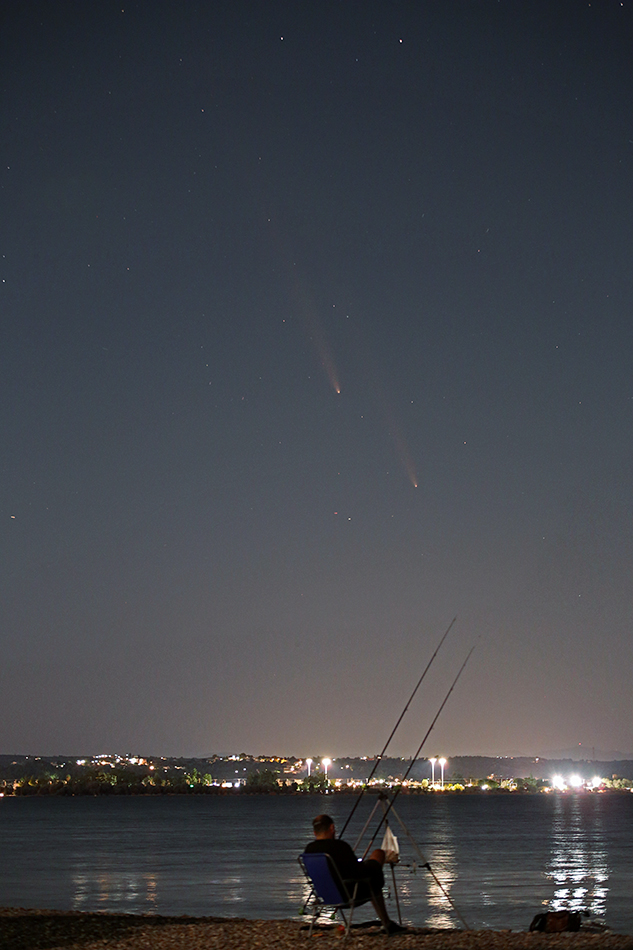 |
Date: Oct 15, 2024 20:22 - 20:32 UT+3 Location: Skala Oropou, Oropos, Greece Equipment: Canon EOS 6D Mk I Baader BCF2 Filter Canon EOS EF 70-200mm f/4 L @ 100mm / f4.0 Exposures: 2 x 0.6 sec ISO 6400 JPG image format 5472x3648 Image Size Custom White Balance Manual Mode Continuous Servo Mode Software: Photoshop CS5 Processing: White Balance Resampling JPG Compression |