
Open star clusters are widely distributed in our galaxy and represent a loose collection of stars which number from a
few dozen to a few hundred stars and are weakly-held gravitationally. Perhaps the three most famous such open clusters
are the Pleiades (M45) in Taurus, the Beehive (M44) in Cancer and the double cluster in Perseus. They are all
characterized with a handful of hot and white prominent stars and nebular material surrounding these stars.
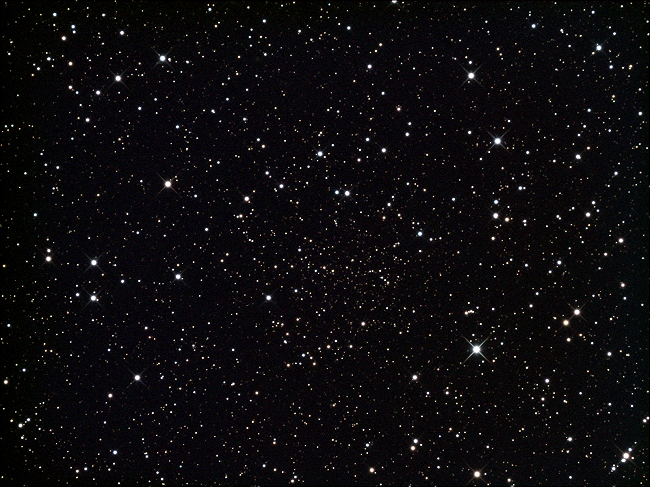
Note: The open star cluster Berkeley 17 in Auriga has the distinction of being the oldest or
second oldest open star cluster in our galaxy. Estimates as to its age range from 10.06 to 10.08 billion years old with
NGC 6791 in Lyra being possibly older at 10.20 billion years old (different studies suggest slightly different estimates
as to the age of NGC 6791). Berkeley 17 is comprised of approximately 100 stars which span approximately 13' in diameter
and with the brightest member star being only magnitude 16. The cluster, estimated to be 2700 parsecs (or 8800
light-years) away, is best observed during late fall and winter when it is directly overhead lying between β-Tau (mag 1.68)
and the Flaming Star Nebula (IC410).
Note: A research paper on Berkeley 17 is available
here.
Please click on the image below to display in higher resolution (1200 x 900)
|
NGC Number: N/A Common Name(s): Berkeley 17 Other Designations: OCL 447, Lund 160 Object Type: Open Cluster Object Classif: III 1 r Constellation: Auriga RA / Dec: 05h 20m 32s / 30° 34' 20" Distance: 8,800 light-yrs Object Size: 13' x 13' Magnitude: 14.0 |
|
Date: Mar 14, 2007 20:00 - 22:05 UT+2 Location: Athens, Greece Equipment: AP 160 f/7.5 StarFire EDF AP 1200GTO GEM SBIG ST-2000XM SBIG CFW10 SBIG LRGB + IR-block Integrations:
Temperatures:
Software: CCDSoft V5.00.182 CCDSharp V1.4 AIP4Win V2.1.19 Photoshop CS2 |