
Nebulae represent clouds of gas and dust which appear as hazy or fuzzy objects when viewed through a telescope and are
characterized as one of four types (emission, planetary, reflection or dark). Emission nebulae, such as the Lagoon
nebula (M8), simply glow, for example, with a stunning shade of red. Planetary nebulae appear as small greenish disks
through a telescope, thus emulating the planets Uranus and Neptune, as a result of gas masses being thrown off by dying
stars (ex. M27, Dumbbell nebula) or represent supernova remnants (ex. M1, Crab nebula). In contrast, reflection nebulae
are characterized with gas surrounding young stars which reflect the stellar light (ex. M45, Pleiades) and, thus, yield
beautiful images of nebulosity. Finally, dark nebulae are detectable and studied only using parts other than the visible
spectrum and are believed to be associated with the formation of stars (ex. M16 in Serpens).
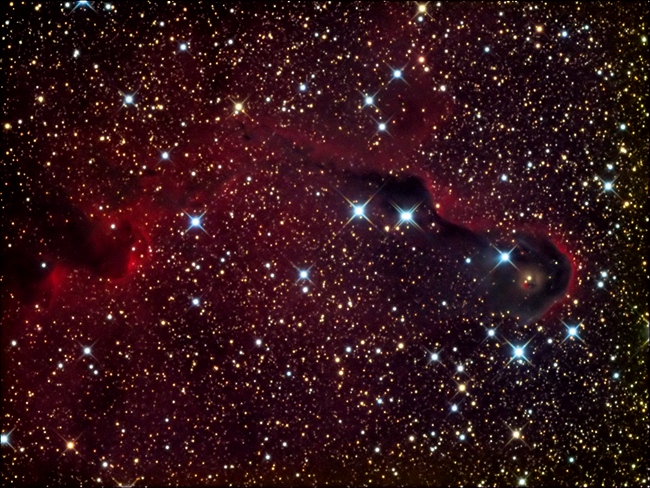
Note: The Elephant Trunk Nebula (IC 1396A) in Cepheus is part of the larger IC 1396 complex
which spans a large area of the sky measuring 170 by 140 arc-minutes and is one of the brightest emission nebulae with a
magnitude of 3.5. The western portion of IC 1396 contains the Elephant Trunk Nebula (IC 1396A) which is characterized with
H-II emissions, dark lanes and globules as well as a small reflection nebula (see small blue patch near the right end of
the trunk). The IC 1396 complex is technically a star cluster (aka Cr 439, Trumpler 37) owing to the presence of a
developing open but loose cluster at the heart of this rich nebulosity and which is evident in the image below. This open
star cluster is comprised of 50-100 member stars which vary in brightness spanning an area of approximately 50' in diameter
and which are not very well detached from the background sky. This stellar nursery lies at a distance of 2,720 light-years
away and is located a few degrees north of the midpoint between Alderamin (α-Cep, mag 2.43) and ζ-Cep (mag 3.34) and includes
the well-known and bright carbon star μ-Cep (Herschel's Garnet
Star, B-V=+2.317).
Please click on the image below to display in higher resolution (1200 x 900)
|
IC Number: 1396A Common Name(s): Elephant Trunk Nebula Other Designations: Sh 2-131, LBN 455 Object Type: Bright Nebula Object Classif: E C AF Constellation: Cepheus RA / Dec: 21h 39m 00s / 57° 29' 10" Distance: 2,720 light-yrs Object Size: 35' x 25' Magnitude: 3.5 |
|
Date: Sep 15-16, 2007 21:05 - 02:40 UT+3 Location: Athens, Greece Equipment: AP 160 f/7.5 StarFire EDF AP 1200GTO GEM SBIG ST-2000XM SBIG CFW10 SBIG LRGB + IR-block Integrations:
Temperatures:
Software: CCDSoft V5.00.182 AIP4Win V2.1.19 Photoshop CS2 |