
Open star clusters are widely distributed in our galaxy and represent a loose collection of stars which number from a few dozen to a few
hundred stars and are weakly-held gravitationally. Perhaps the three most famous such open clusters are the Pleiades (M45) in Taurus, the
Beehive (M44) in Cancer and the double cluster in Perseus. They are all characterized with a handful of hot and white prominent stars and
nebular material surrounding these stars.
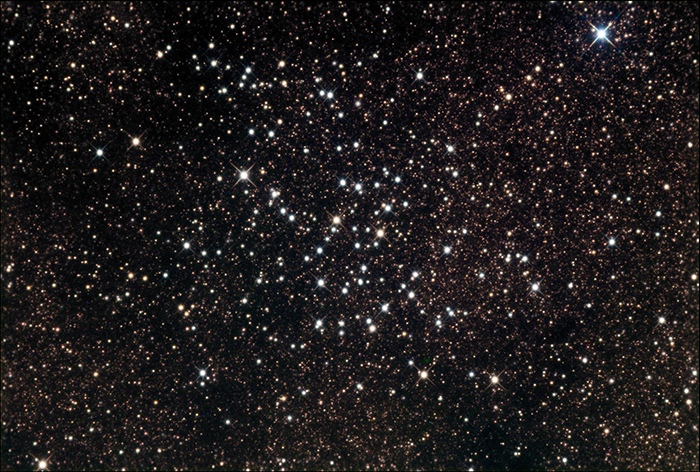
Note: Open cluster NGC 6494 in Sagittarius depicted below is a rich dense cluster comprised of over 100 member
stars which are of uniform brightness and well detached from the rich background sky. The cluster spans 30 arc-minutes in diameter or 15-20
light-years across. M23 lies at a distance of 2,150 light-years away and is dated at a mere 220-300 million years-old and as evidenced by
the predominance of white hot stars in the image below. The cluster is best observed using low magnifications (50-100x) during mid-summer
as it approaches the southern meridian near midnight. NGC 6494 was discovered by Charles Messier in 1764.
Please click on the image below to display in higher resolution (1200 x 950)
|
NGC Number: 6494 Common Name(s): N/A Other Designations: Cr 356, Mel 184 Object Type: Open Cluster Object Classif: II 2 r Constellation: Sagittarius RA / Dec: 17h 56m 52s / -18° 59' 12" Distance: 2,150 light-yrs Object Size: 30' Magnitude: 6.9 |
|
Date: May 10, 2010 02:40 - 04:50 UT+3 Location: Athens, Greece Equipment: AP 160 f/7.5 StarFire EDF AP 1200GTO GEM SBIG ST-10XME SBIG CFW10 SBIG LRGB filters Integrations:
Image Scale: 1.17" per pixel Temperatures:
Software: CCDSoft V5.00.195 CCDStack V1.6.0.5 eXcalibrator V1.0.3.0 Aladin V6 Photoshop CS2 |