
Herbig-Haro ("HH") objects are small emission nebulae found around young developing stars (protostars) and which are
believed to be transient in their nature, for they only exist for a few thousand years. These pockets of small nebulae
were first described by American astronomer George Herbig and Mexican astronomer Guillermo Haro during the mid-1940's
while studying NGC 1999. These objects can be regarded as by-products of star formation due to the fact that gases
emitted by newly forming stars collide with surrounding interstellar dust and gas, thus generating shock waves which lead
to the ionization of gas and the consequent emission of visible light thanks to the ensuing recombination of ions with
free-floating electrons. To this end, these objects are especially impressive sights when observed or photographed in
hydrogen, sulphur and oxygen given the propensity for the emission lines to be strong in this part of the spectrum and,
in contrast, to infrared to which they are invisible.
HH objects are characterized with very little mass (1 to 20 earth-masses), are very dense and have temperatures around
10,000 degrees Kelvin. Herbig initially described 43 such objects ("A Draft Catalogue of Herbig-Haro Objects",
1974) and this number has grown recently to over 400 such entries. The interested reader is referred to the works of
Reipurth ("A General Catalogue of Herbig-Haro
Objects", 1999) as well as Chu et al
("A Study of the Energy Sources of Herbig-Haro Objects", 2002) where additional HH objects have been identified
and catalogued.
Note: HH 215 in Cepheus is more commonly known as Gyulbudaghian's Nebula and is named after
the Russian astronomer credited with its discovery in 1977. It is unique for it is variable in both size and shape and
represents one of the largest examples of a Herbig-Haro object with a diameter of 7.5 arc-minutes. The nebula is at the
apex of the pre-main sequence star PV Cephei with spectroscopic studies having identified a 40 arc-second jet emanating
from the star LkHalpha 234. Due to the high rotation of material surrounding this protostar, material is ejected in two
opposing directions and which interacts with surrounding gas, thus leading to a bipolar nebula. In the case of
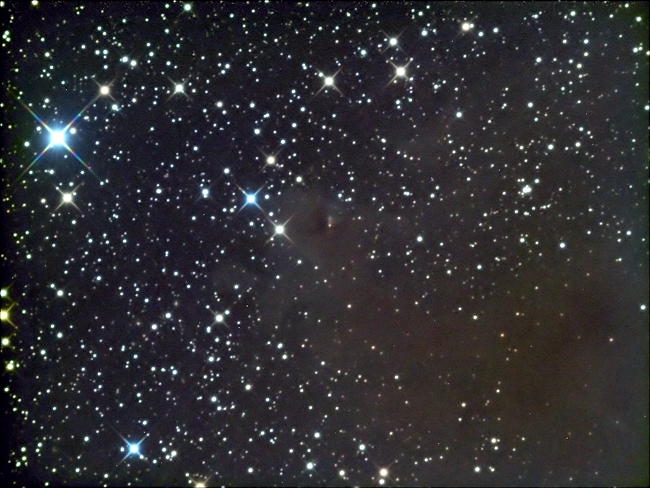
Gyulbudaghian's Nebula, the image below depicts one of the two fans of the ejected material whereas the fan in the
opposing direction is obstructed by a dark nebula. The nebulosity encases a handful of stars of magnitude 9.5 to 10.5 as
well as the open but poorly populated star cluster NGC 7129 measuring 2.7'.
Please click on the image below to display in higher resolution (1200 x 900)
|
HH Number: 215 Common Name(s): Gyulbudaghian's Nebula Other Designations: PP 97, RNO 125 Object Type: Bright Nebula Object Classif: HH Constellation: Cepheus RA / Dec: 20h 45m 54s / 66° 58' 28" Distance: 0,000 light-yrs Object Size: 1.9' x 1.4' Magnitude: 00.0 |
|
Date: Sep 17-18, 2007 21:30 - 03:00 UT+3 Location: Athens, Greece Equipment: AP 160 f/7.5 StarFire EDF AP 1200GTO GEM SBIG ST-2000XM SBIG CFW10 SBIG LRGB + IR-block Integrations:
Temperatures:
Software: CCDSoft V5.00.182 AIP4Win V2.1.19 Photoshop CS2 |