
Although the moon has been observed by amateurs and professionals for many centuries, a phenomenon which is considered extremely rare is that of a lunar ray. More specifically, when the rising or setting sun is at a very low angle relative to a lunar feature such as a crater, even a couple of degrees, sunlight may pierce through one of the clefts in the crater's wall and project a ray across the crater floor. Although observational reports of such rays date back to the mid-1800's, there exist but a few such reports and even fewer images. This project is something I started to pursue during the spring of 2003 after reading the excellent article by Robert Robinson in the Reflector (Dec/2002, pg 15). To date, reports indicate that these rays may be observed for only a handful of craters and only during a two- to three-hour window.
|
Crater: Curtius Quadrant: SE Lunar Coord: 67.2° S, 4.4° E Diameter: 95.0 km Height: 0 km Rukl: 73 Lunation: 08d 01h 51m |
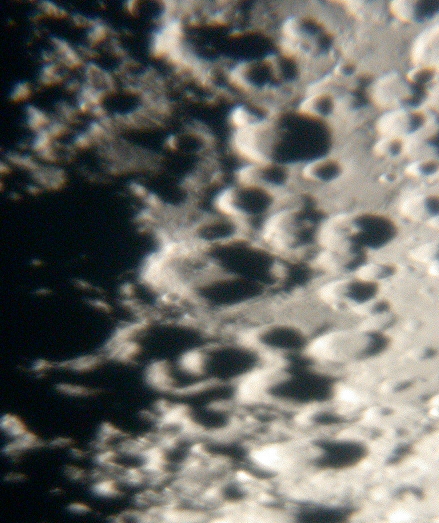 |
Date: Jun 07, 2003 21:15 UT+3 Location: Athens, Greece Equipment: Celestron 14" SCT Losmandy G-11 Nikon Coolpix 995 ScopeTronix STWA14 Adapter Exposure: 1/30 sec @ f4.0 ISO 400 JPG RGB Fine image format 2048x1536 image size Autodark subtraction Software: Photoshop V6 Processing: Unsharp Masking Resampling JPG Compression |