
I have a particular interest in satellite transits across the solar/lunar surfaces due to the opportunity they present the lucky observer
to discern greater physical detail and structure as a result of their silhouette against the bright background of the Sun and/or Moon; the
ability to restrict the satellite's location in the daytime or evening sky to an area measuring 0.5°x0.5° with little or no effort; it
permits for the bypassing of satellite tracking which itself is a challenge due the very short period transits are visible during a particular
overhead pass; and the difficulty in obtaining accurate and timely orbital elements and TLE's. As this "search and identify" project has
literally become a frequent ritual, I expect this web page to be updated constantly with more and more images of the very unique phenomena of
satellite transits across the solar and/or lunar disks.
Note: The capture of a solar transit by the International Space Station was an incessant chase for 3-4 years and
until July 28, 2005 when the ISS (with
STS-114)
was finally captured transiting against the Sun and which included the space shuttle Discovery. Approximately nine months later, the ISS was
also caught transiting the rising moon (click
here) albeit at a very low altitude. My best ISS transit captures occurred in
2018 and 2023
when the ISS was at a range of 441.6 km and 551.4 km away, respectively, when transiting the Sun whereas in 2010 I was able to also capture
the ISS during the day transiting Jupiter at a range of 439.5 km as well as
Mars at a range of 565.9 km.
With the launch of the Chinese Space Station Tiangong-1 module in 2011 and the Tiangong-2 module in 2016, a new challenge presented itself
and where a small number of transit opportunities have presented themselves involving both the Sun and Moon. However, orbital maneuvers and
the weather play a vital role with such events and, regrettably, they proved repeatedly to be prohibitive stumbling blocks. However, both on
Aug 29th, 2023 and Jul 05, 2024 everything seemingly came together thanks to a stable orbit, favourable weather conditions and the very good
altitude of Sun which finally permitted for the pursuit and successful capture
(here and here)
of the Tiangong Space Station transiting the Sun for a mere 0.69 and 0.54 seconds respectively. The effort below represents the fourth successful
capture of the Chinese Space Station Tiangong transiting the Sun in a span of less than twenty-four months but this time at a range of 400 km and
with a transit duration of 0.46 seconds and apparent diameter of only 9.29 arc-seconds. The high angular velocity of Tiangong (63.0 arc-mins/sec)
did not prove to be an issue owing to the Player One Neptune-M (IMX178) webcam allowing for an exposure of 0.34 msec and in contrast to the slight
blurring due to motion (and/or vibration) in earlier efforts using a Canon EOS 6D DSLR camera in burst mode.
The Chinese Space Station Tiangong ("Sky Palace") represents China's most recent entry into space and follows the Tiangong-1 and
Tiangong-2 modules. It is approximately one-third the size of the ISS (by volume) and has a permanent crew of three astronauts but can accomodate
up to six astronauts during missions involving crew rollovers. It has a current mass of 96,000 kg and measures 55.6 meters in length and 39.0
meters across with plans to expand the station from the three existing modules to a total of six modules in the future with the fourth module
("Xuntian") tentatively scheduled for launch in 2024.
Note: For a video representation of the transit in real time (Speed: 1.0x) as well at a much reduced rate (Speed: 0.1x),
click here.
Note: For a complete set of images captured so far involving satellite transits of both the Sun and Moon,
click here.
|
Satellite(s): Tiangong USSPACECOM Cat No: 48274 (Tianhe) Physical Dimensions: 55.6 x 39.0 m Orbit / Inclination: 381 x 390 km, 41.47° Range (Image): 400.53 km Angular Diameter: 9.29" Pass Details (Tiangong):
Launch Date (UTC):
|
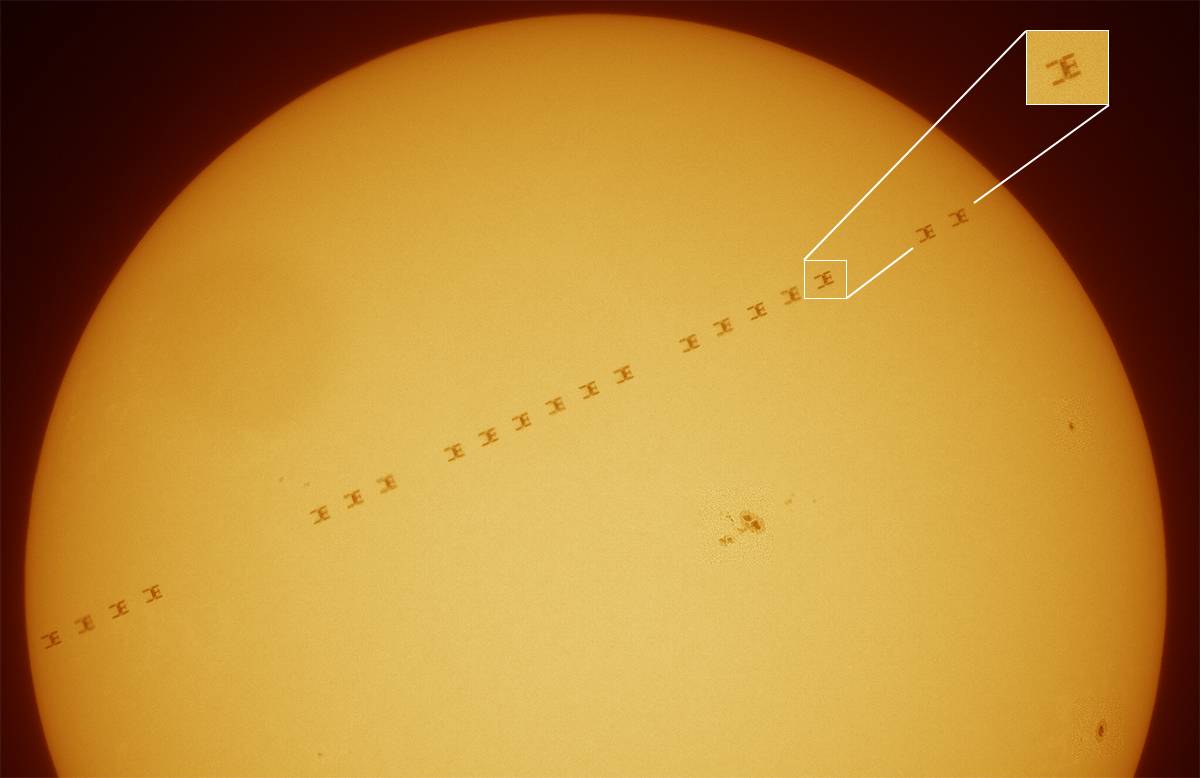 |
Date: Jun 15, 2026 14:04:35 UT+3 Location: Athens, Greece Equipment: Takahashi FSQ 106/f5 APO AP 1200GTO/CP3 GEM Player One Neptune-M (IMX178) Baader Solar Continuum 10nm Baader ND-5 (full-aperture) Video Imaging:
Image Scale: 0.94" / pixel Software: FireCapture V2.7.14 AutoStakkert V4.0.11 PIPP V2.3.8 Registax V6.0 Photoshop CS6 Processing: SER to TIFF (8-bit conv) Registration & Alignment Selective Sampling (5%) Deconvolution Cropping JPG Compression |
||||||||||||||||||||||||||||||||||||||||||||||||