
Clouds are one of the most dominant features which characterize our planet, for they blanket a good portion of the planet each and every day.
These formations represent water in various states (solid: snow or ice crystals, liquid: water, gaseous: vapour) and are generally categorized
into one of three types based on their altitude and one of four types based on pattern (further details available on this website
here).
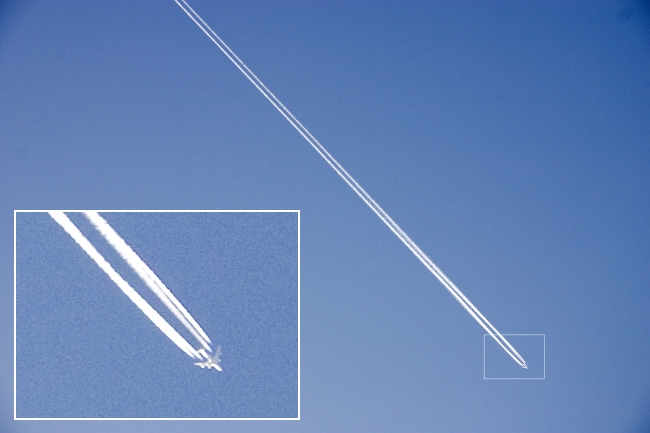
Some special cloud formations with widely-recognized terms include "fog" where a cloud is in contact with the ground and "contrails" where
vapour from jet engine exhausts crystallizes into ice particles due to the high-altitude of the airplane and associated cold temperatures.
Although contrails (or vapour trails) forming as a result of water condensing into ice crystals do not represent any form of air pollution,
it is possible for these formations to also occur due to engine exhaust and which contain various fuel combustion byproducts and contaminants
and, thus, can be considered as pollution.
Contrails are believed to have a minor impact on warming of the immediate environment, for they suppress the release of longwave radiation at
a greater rate than the reflection of incoming solar radiation due to albedo.
 |