
An aspect of astronomy which is very exciting is the handful of stars which have been found to be characterized with very
high proper motion. To be more specific, the position of stars is virtually identical from century to century (let alone,
year to year!) and, yet, a very small number of these stars show dramatic motion across the sky when observed from year
to year. This rapid motion which is easily identified using parallax techniques strongly suggests that these stars are
very close to our sun and solar system with distances often being less than ten light years (many galaxies, for example,
are hundreds of thousands of light years away). The most dramatic of these stars is Barnard's Star which has a proper
motion slightly in excess of ten arc-seconds per year (!), is estimated to be approximately 5.94 light years away and is
currently passing through the constellation of Ophiuchus. Other examples of interest include Wolf 359 (4.70" per year,
Leo), Lalande 21185 (4.80", UMa) and Lacaille 9352 (6.90", PsA). The most recent discovery (2002) is Teegardner's Star
in the constellation of Aries where preliminary estimates suggest a proper motion of 5.05" per year with a distance of
approximately eight light years from the sun.
Note: For many decades 61-Cygni was characterized with the greatest proper motion of any star
and in spite of the fact it was first noted to have a high proper motion as early as 1792 by Guiseppe Piazzi
who immediately named it "Flying Star". To add further to its uniqueness, 61-Cygni was determined to be a binary system
in 1830 by Friedrich Georg Wilhelm von Struve and, hence, for its current designation of 61-Cygni AB. Finally, it is the
brightest of any high-proper motion star and is easily visible with the naked eye and/or consumer binoculars. Further
information in relation to 61-Cygni is available
here.
Please click on the image below to display in higher resolution (1200 x 950)
|
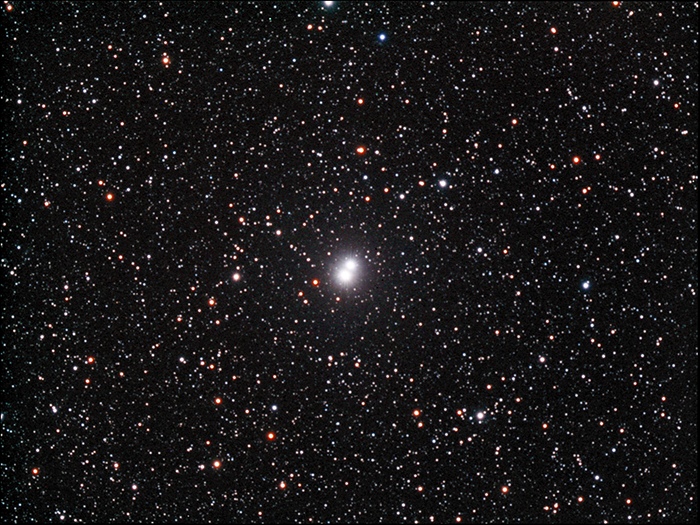
Object: 61 Cygni A/B Common Name(s): None Other Designations: HIP 104214 / 104217 Object Classif: K-class main seq Constellation: Cygnus RA / Dec: 21h 06m 54/55s / 38° 44' 57/31" Luminosity: 0.085 / 0.039 x Sun Mass: 0.70 / 0.63 x Sun Diameter: 0.72 / 0.67 x Sun Distance: 11.4 light-yrs Proper Motion: 5.28 / 5.17 " per yr Magnitude: 5.20 / 6.05 |
|
Date: June 10, 2010 02:10 - 04:15 UT+3 Location: Athens, Greece Equipment: AP 160/f7.5 Starfire EDF AP 1200GTO GEM SBIG ST-2000XM SBIG CFW-8A Baader LRGB filters Integrations:
Image Scale: 1.27" per pixel Temperatures:
Software: CCDSoft V5.00.195 CCDStack V1.6.0.5 eXcalibrator V1.0.3.0 Aladin V6 Photoshop CS2 |