
Herbig-Haro ("HH") objects are small emission nebulae found around young developing stars (protostars) and which are
believed to be transient in their nature, for they only exist for a few thousand years. These pockets of small nebulae
were first described by American astronomer George Herbig and Mexican astronomer Guillermo Haro during the mid-1940's
while studying NGC 1999. These objects can be regarded as by-products of star formation due to the fact that gases
emitted by newly forming stars collide with surrounding interstellar dust and gas, thus generating shock waves which lead
to the ionization of gas and the consequent emission of visible light thanks to the ensuing recombination of ions with
free-floating electrons. To this end, these objects are especially impressive sights when observed or photographed in
hydrogen, sulphur and oxygen given the propensity for the emission lines to be strong in this part of the spectrum and,
in contrast, to infrared to which they are invisible.
HH objects are characterized with very little mass (1 to 20 earth-masses), are very dense and have temperatures around
10,000 degrees Kelvin. Herbig initially described 43 such objects ("A Draft Catalogue of Herbig-Haro Objects",
1974) and this number has grown recently to over 400 such entries. The interested reader is referred to the works of
Reipurth ("A General Catalogue of Herbig-Haro
Objects", 1999) as well as Chu et al
("A Study of the Energy Sources of Herbig-Haro Objects", 2002) where additional HH objects have been identified
and catalogued.
| Herbig-Haro Objects | |||||
|---|---|---|---|---|---|
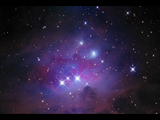 HH 45 in Ori Running Man Nebula |
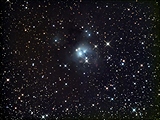 HH 167 in Cep |
 HH 215 in Cep Gyulbudaghian's Nebula |
 |
|
|
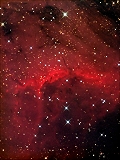 HH 555 in Cyg |
|||||